
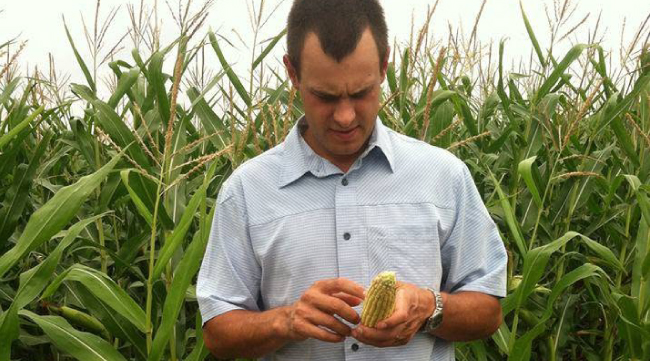
Hidden Stories Among Us
From Guesswork to GPS: How Technology Transformed the Farm
August 2026
Every August 6th, Farmworkers Appreciation Day gives us a chance to pause and recognize the people who put food on our tables. These are the same people who often work long hours through unpredictable weather, tight planting windows, and the physical demands of the land.
But behind many of today’s farmers is a quieter revolution. The equipment they use today has changed almost beyond recognition over the past few decades, allowing them to accomplish in a single day what once took nearly three.
Tom Wald watched that revolution unfold from the front seat. He began his career in 1988, selling agriculture equipment for Butler Machinery. “Back then, there weren’t even any “buddy” or instructor seats in tractors,” he says. That extra seating, now common in tractor cabs, was just the beginning.
New Technology Reshapes the Fields… and the Future of Farming
Perhaps the biggest headache for farmers back in the late 1980’s, was equipment compatibility, Wald says. Many farmers owned three or four different pieces of machinery from different manufacturers, and each one ran on its own proprietary system. Switching between them meant juggling separate displays for every task. “Now, they can have several different pieces of equipment and run all of them with one operating system,” Wald says. “One ISO operating system is now the industry-standard software that comes built into nearly every new machine.”
Auto steer changed the game as well, letting equipment hold a precise line through a field with far less physical strain and far more efficiency than a farmer steering by hand ever could.
Some of the most striking advances Wald has seen involve the planting of seeds, specifically how they go into the ground. Older planting equipment left farmers to make educated guesses about seed depth, adjusting by feel for whether the soil in a given patch was hard-packed or loose. Today’s row-crop planters do that work automatically, sensing soil conditions and adjusting depth on the fly, even within the same field.
The same precision now extends to fertilizer. Wald says modern systems let farmers apply exactly what a specific patch of ground needs, no more, no less. “Rather than spreading a uniform rate across an entire field, equipment can now pinpoint fertilizer use more efficiently. So, areas that don’t need as much simply don’t get it, which saves farmers money and keeps excess fertilizer out of the ground.”
Even equipment maintenance has become smarter. Dealers now receive automatic diagnostic codes straight from the machinery, often flagging a problem and dispatching a mechanic before the farmer even notices anything is wrong.
Efficiency: The Difference Between Profit and Survival
For a farmer working the ground today, those advances are the difference between a good season and a great one. Thomas Vetter farms soybeans and sunflowers on lands scattered across Linton, Wing, McKenzie and Driscoll. Vetter wasn’t raised on a family farm growing up in Wyoming. He lived in the city, but he worked for farmers, even spent his summers working on a dairy farm east of Linton. He eventually earned a degree in Agriculture Business, came to North Dakota to learn from his uncle how to build a farming operation from nothing, and now lives in Bismarck and rents every acre he farms: 40 fields cropped each year, spread across 15 landlords, with fields ranging from 80 acres up to 1,100.
Farming that much ground with a small crew means efficiency isn’t optional. It’s survival. Vetter does most of the work himself, has one full-time employee and four part-time farmhands in the busy months. “In the beginning, I farmed with nothing, so I had much more to risk," Vetter says. “I’ve had to learn how to farm efficiently from the beginning because I didn’t have a farm family; I just had myself.”
That’s where the new generation of equipment has made the difference. Vetter now runs a high-speed planter that moves at nine to 11 miles per hour, roughly double the pace of the traditional planters. “I’m getting a lot more done in less time,” he says. When he started farming 14 years ago, he used an older corn planter to seed 250 acres a day. Today, he can seed up to 800 acres a day.
Speed isn’t just about covering more acres; it’s about outrunning the weather. Getting seed into the ground faster means Vetter can plant during the narrow windows when conditions are ideal, rather than being at the mercy of a single stretch of decent weather. “In the earlier days, you didn’t have that technology, and you had to plan out your planting window based on unpredictable weather patterns,” Vetter says.
Down-pressure technology has advanced right alongside planting speed. Older planters relied on spring-based down pressure; Vetter’s equipment has moved to hydraulic down pressure, adjusting the exact force needed to seed properly whether the dirt is soft or hard. “This gives me a much better stand and more accuracy,” he says, “so it’s quicker and much more accurate.”
Auto steer and auto-track systems free up something just as valuable as time. With the machine holding a straight, accurate line on its own, Vetter can run the rest of his operation from the cab.
“I can sit there while it’s planting and do other business,” he says. “I can sign loans through e-sign from the tractor, run my other businesses, or call one of my workers to deliver something somewhere.”
If any single piece of equipment reshaped modern agriculture, Vetter says, it’s the sprayer. Today’s large fertilizer sprayers can cover ground at up to 23 miles per hour, compared to the 6 or 7 miles per hour sprayers managed in years past. Bigger tanks mean fewer stops to refill, and camera systems can now identify weeds and target them individually. “They have eyes that can see the weeds, so it can just spray the weeds only,” Vetter said. “This saves me from using more chemical than what is needed, so it saves me money.” New nozzle designs have cut down on chemical drift, and variable-rate technology now applies to seeding as well, letting Vetter customize input levels across a single field rather than treating every acre the same.
And then there’s the tool that doesn’t look like farm equipment at all: the cell phone. “I can sign business agreements, deposit checks, and make transfers,” Vetter says. “Without it, I would need a secretary.”
More Than Just Faster
Farming remains hard, physical, weather-dependent work. But the technology that Wald was selling at Butler Machinery 35 years ago, and the tools that Vetter now relies on every planting season, have given farmers something that used to be in short supply: time. Time to manage more acres, run other ventures alongside the farm, and to make more precise decisions about the land itself.
For farmers like Vetter, who built an operation from the ground up with no family land to inherit, that shift hasn’t just made farming faster, it’s made it possible.
Farmworkers Appreciation Day, observed August 6, is a fitting time to recognize both the people and the innovation behind the meals we eat every day.
More stories in this Issue

A Promise Kept
August 2026

Message from the CEO
August 2026

Behind the Board
August 2026

Help BEK TV Make History!
August 2026
Hidden Stories Among Us
August 2026

BEK TV Scores Another Touchdown
August 2026

Deadline Approaching!
August 2026

Click Smart – Stay Cyber Safe
August 2026
