
Hidden Stories Among Us
A Letter Found, and A Story Returned
February 2026
Opening A Window to the Past
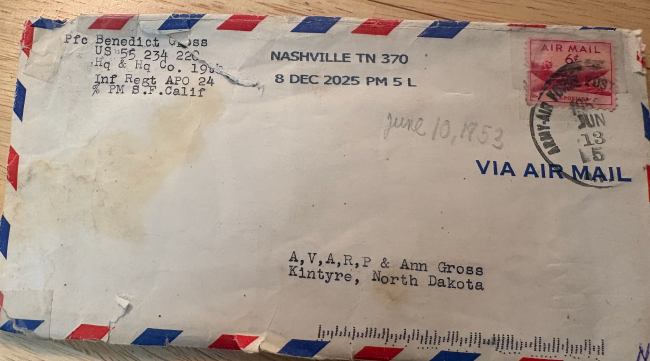
Just days before Christmas of 2025, Ann Moch opened her mailbox in Kintyre and found something time forgot… a piece of the past just begging to be opened.
Tucked among Christmas cards was a fragile envelope. It was faded in color, and the adhesive that once kept it sealed was worn away. Complete with a six-cent stamp, the envelope had been delivered via Air Mail by the Army. The return address belonged to PFC Benedict Gross, and it was addressed simply to his family in Kintyre, with no house or street address. But the part that caught Anna’s eyes most was the stamp date: June13, 1953.
“I had to look at it several times,” Ann said. “I noticed the date first, and then I just stood there wondering where it had been.”
Curiosity took over, and Ann says she pulled out a three-page letter written by a 22-year old American soldier, Benedict Gross. Little did she know that she was about to travel back in time more than 70 years. “It was written like diary entries,” she says. “He acknowledged that he had received cookies his family has sent to him, and he talked about life at the time in Japan.”
Ann says Benedict wrote about his time visiting Japanese orphans there and the role he played as a chaplain assistant, but he also wrote about the emotions felt as soldiers prepared for battle in Korea. “There was a real sadness reading about the conditions that these men were living in and what they had to do.” Ann says that Benedict wrote about being put on high alert and how soldiers dreaded going to the front lines. He wrote about one soldier who didn’t make it back and how he helped plan a funeral service for him. And he wrote about his duties as a guard, overseeing the hundreds of captured Japanese.
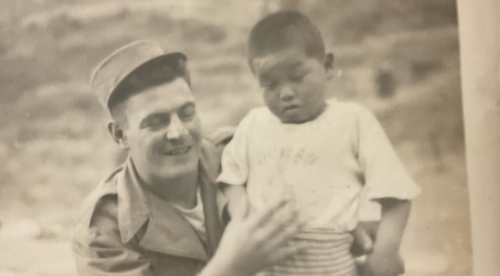
Ben and an orphaned child in South Korea, 1953
She eventually made the connection. Benedict Gross was one of 16 children born to John M Gross and Magdalena Vetter, and their family farm was not too far away from where Ann lived in Kintyre. “I saw the name of Anne Gross, Benedict’s sister, written on the envelope, and she had married my first cousin, so this letter was lost, but I knew where it belonged.”
Letters That Meant Everything
Isadore Gross is the second youngest of the 16 Gross children and the little brother to Benedict. Today, the 80-year old still lives in Kintyre, but he was only seven years old when the letters were first mailed to his family.
“Both of my brothers, Benedict and Andrew, wrote letters all the time to us while they were stationed together in Japan.” He says his mother encouraged the children at home to write to their brothers and to send care packages. He says it was a way for the family to feel connected to the boys in uniform. “I remember one time they sent us a record with their voices on it, and we played it at home on the phonograph. Just hearing their voices was wonderful!”
Memories Rediscovered
After connecting with the Gross family and returning the letter, Ann learned the surprise twist to this story: the letter had made it home in 1953 and only went missing decades later.
Years after Benedict and Andrew returned home from serving in the U.S. Army during the Korean War, another of their younger siblings, Valentine, discovered two dozen letters that Benedict had written during that time. He called his big brother, now 95-years old and living in Georgia, and Benedict asked him to send the letters to him. So, Valentine placed the letters into a single envelope and sent them through the mail, but somewhere along the way, the envelope was damaged. All but one of the letters fell out.
Benedict says he hasn’t seen the letters since the day he wrote them. “Some things I didn’t remember at first, but when I read that one letter I received, it all came back,” says Benedict. “Some things I knew exactly where I was when I wrote them. It took me back there, and that isn’t a bad thing for me.”
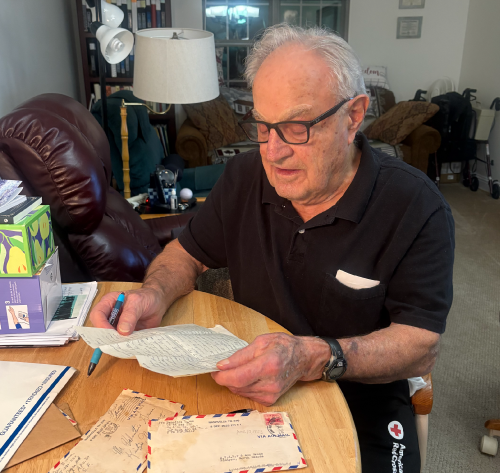
Benadict today with some of the letters he wrote to his family while serving in the Army in the 1950s
Perhaps his recollection of that time isn’t all bad because he chose to focus on the good things he was doing. Plus, the military warned soldiers of saying too much. “The Army told us on our way over there that our letters might be censored, so we needed to be careful what we wrote about. I tried not to write too much having to do with battle.”
More Than a Coincidence?
Mail in the 1950s often listed only a family name, city, and state, so today’s postal service didn’t know exactly where to deliver the lost letters from that damaged envelope that Valentine mailed to Benedict last Fall. Yet, one by one, they began reappearing in mailboxes in the Kintyre area. One of them ended up in Ann Moch’s mailbox. Eight others were returned to siblings. The remaining 15 remain lost.
“I’m so grateful that one of them showed up in good enough shape in my mailbox,” says Ann. “I’m glad the family got to enjoy it again.”
“We were born in the 30’s, so we saved everything,” Benedict laughs. “It means a lot that my brother saved my letters.”
For Ann Moch, the timing felt meaningful. “I don’t think this was random. Reading about a soldier’s experience during the holiday season made the moment even more powerful.”
Letters written more than 70 years ago have completed their second journey and reconnected a family, community, and history that refuses to be forgotten.
More stories in this Issue
Hidden Stories Among Us
February 2026

Message from the CEO
February 2026

Love in Action
February 2026

BEK TV Helps Lift Local Nonprofits
February 2026

Billing Made Simple
February 2026

Apply Today
February 2026

Front-Row Seats to Local Hoops on BEK TV
February 2026

What’s On Your Mind? With Scott Hennen
February 2026

Behind the Board
February 2026

BEK Earns Top Cybersecurity Honor for 3rd Year
February 2026

Apply Today for A Trip to Washington, D.C.
February 2026

Building Smarter Rural Communities Together
February 2026

Click Smart – Stay Cyber Safe
February 2026
